

Our recent paper in Nature Communications, From stars to molecules: AI guided device-agnostic super-resolution imaging, introduces a deep-learning approach to super-resolution imaging that can work across very different optical systems without device-specific calibration or retraining. Instead of learning one particular microscope or telescope, the model learns from millions of simulated images spanning a broad range of imaging conditions. Once trained, it can reconstruct a super-resolved image directly from measured data without knowing the point-spread function, numerical aperture, noise level, or other parameters of the imaging system.
Learning imaging rather than a particular instrument
Deep-learning methods for super-resolution usually need training data that closely reproduce the optical system on which they will later operate. Even relatively small changes in the point-spread function, noise, emitter brightness, or density can therefore require new calibration data and retraining. Our approach reverses this strategy. The device-agnostic modeling network (DAMN) is trained entirely on numerically generated images in which these parameters are deliberately varied over broad ranges. The training data include different widths and shapes of the point-spread function, different emitter densities and brightnesses, background noise, and optical asymmetries. The resulting network learns a reconstruction strategy that is largely independent of the particular instrument.
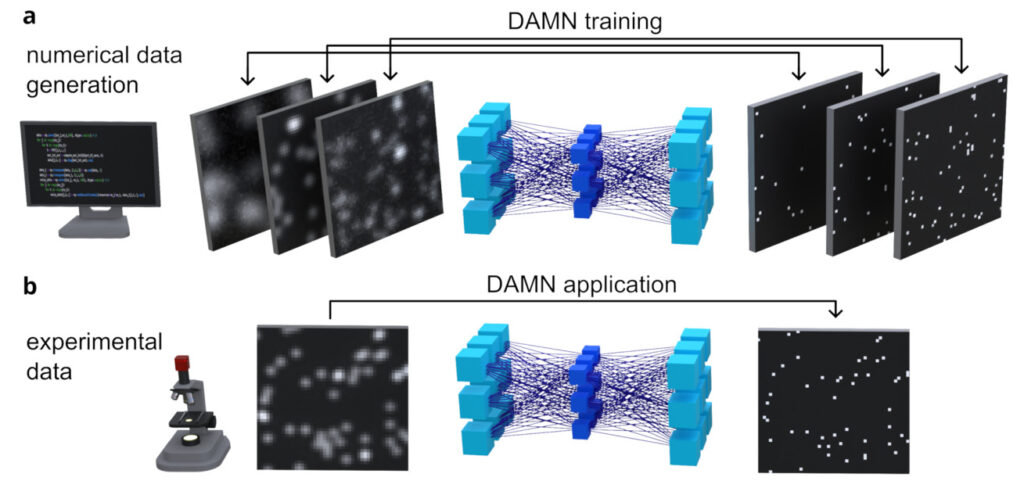
An important consequence is that reconstruction requires only the measured image itself. There is no measurement of the point-spread function, no parameter estimation, and no retraining for a new instrument. In numerical benchmarks, the device-agnostic model outperformed Richardson–Lucy deconvolution and the device-specific Deep-STORM neural network by as much as two orders of magnitude in reconstruction error, even though these competing methods were supplied with information about the imaging system.
Experimental test with a known ground truth
Super-resolution algorithms are difficult to test experimentally because the exact positions of the objects being imaged are normally unknown. We therefore built an optical setup in which a digital micromirror device creates controlled distributions of point-like emitters. Their positions are known precisely, while a lower-resolution microscope produces the blurred images supplied to the reconstruction algorithms.
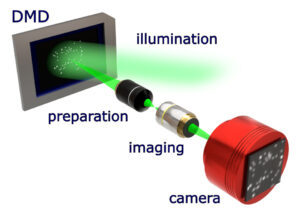
This makes it possible to compare reconstructed experimental images directly with their ground truth. DAMN again outperformed both conventional deconvolution and Deep-STORM. In a representative image containing almost 200 emitters, it resolved neighboring sources separated by a distance almost four times smaller than the Rayleigh resolution limit, without using any calibration information about the imaging system.
The same AI from stars to molecules
The central test of device-agnostic learning was to take the trained model outside our own experiment. We applied the same upsampling DAMN model, without recalibration, retraining, or preprocessing, to experimental data originating from completely different fields and instruments.
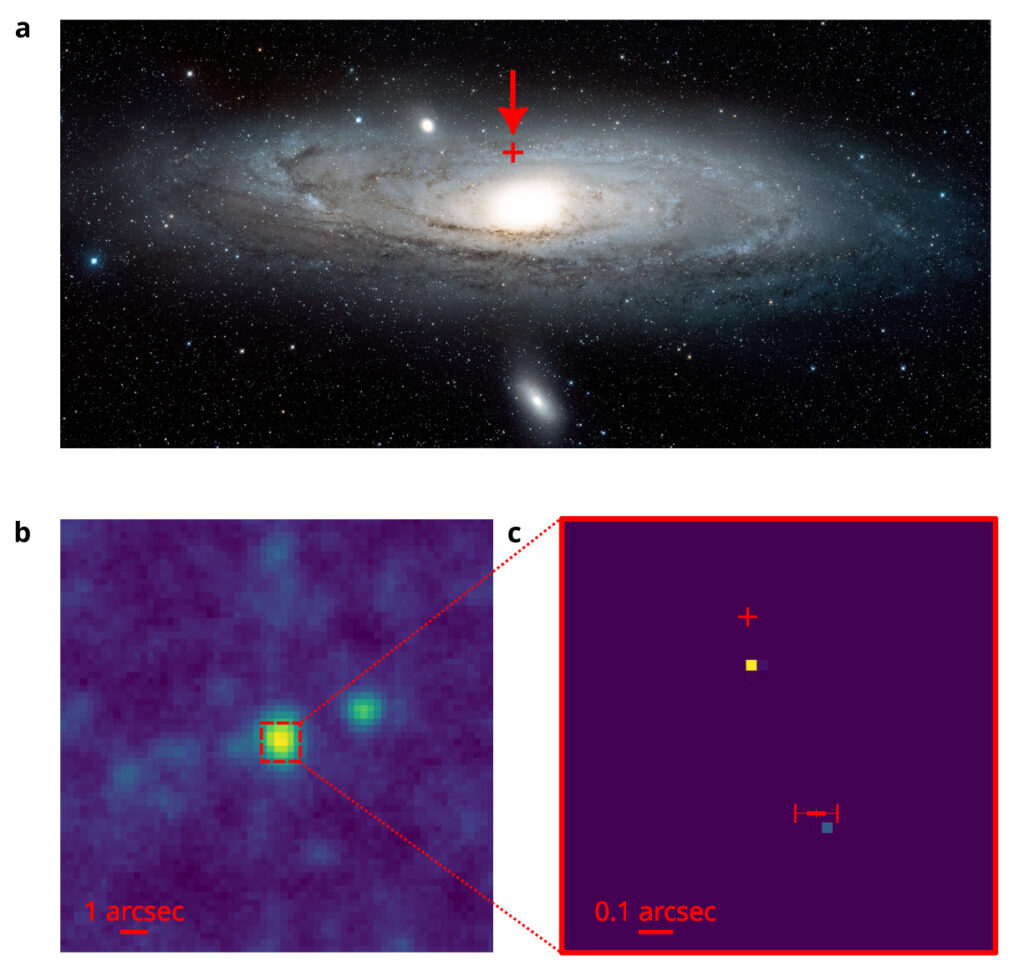
At the astronomical scale, we analyzed a Pan-STARRS1 image of the outer field of the Andromeda galaxy. Two stars separated by about 0.6 arcseconds appear as a single unresolved source in the original ground-based image because their separation is well below the approximately 1.4-arcsecond Rayleigh limit. The neural network resolves the two stars without knowing anything about the telescope, reconstructing a separation of 0.52 arcseconds in agreement with independent Gaia astrometric data.
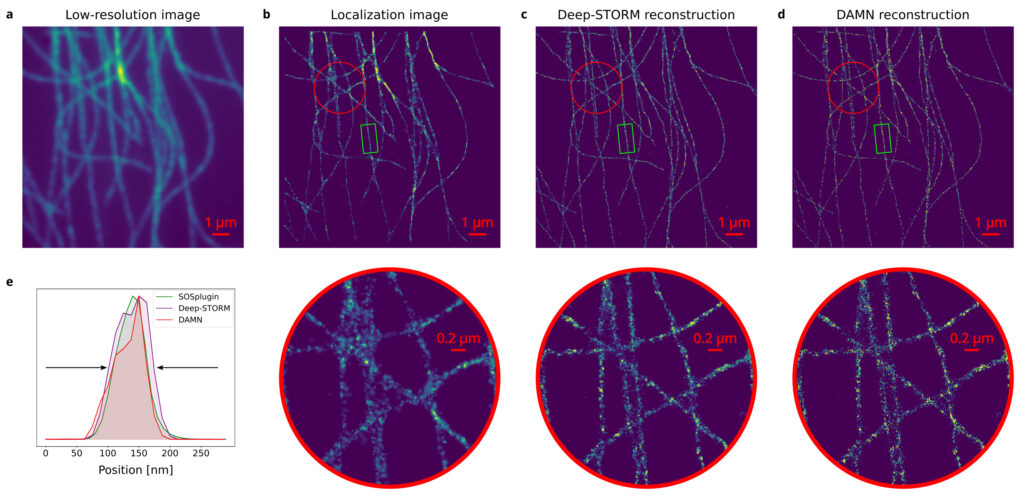
At the opposite length scale, we applied the same approach to single-molecule localization microscopy. On densely labeled tubulin data, DAMN reconstructs narrow microtubule structures with a measured width of about 55 nm, comparable to localization microscopy and sharper than the tested device-specific Deep-STORM reconstruction. We also reconstructed nuclear pore complexes, recovering their characteristic nanoscale ring structure and emitter spacing.
Toward universal image reconstruction
The main result is therefore not a neural network specialized for one microscope or one type of sample, but a different way of training AI for physical measurements. By deliberately exposing the model to a sufficiently broad range of simulated instruments and experimental conditions, it becomes possible to make the reconstruction device-agnostic. A trained model can then be transferred between optical systems without repeatedly characterizing the hardware and collecting new calibration datasets.
The concept is also broader than super-resolution microscopy. Device-agnostic training can in principle be combined with different neural-network architectures and extended to other imaging, sensing, and parameter-estimation problems where robustness to changing or unknown hardware is important. In this sense, going from stars to molecules with the same AI model is not only a demonstration of super-resolution. It is a step toward machine-learning methods that learn the underlying measurement problem rather than a particular experimental device.
Article published in Nature Communications: https://doi.org/10.1038/s41467-026-75584-7
Featured image by Monika Tomanová, https://monikatomanova.art/, Instagram @monikatomanova.art
